
Cytoskeletal Dynamics & Molecular Motors
How do molecular machines move and route cellular cargo?
Microtubules form polarized tracks for intracellular transport. Dynein and kinesin move along these tracks, carrying cargo and generating forces needed for cellular organization and division. Their behavior depends on the nucleotide state of the motor, the forces it experiences and the molecular environment of the track. We ask how these factors act together to determine whether a motor binds, steps, detaches or is excluded from a region of the microtubule.
We investigate these questions with all-atom molecular dynamics, elastic network models, enhanced sampling and free-energy calculations. Collaborations in cryo-electron microscopy and single-molecule biophysics connect our atomistic models to structural and motility measurements. This combination lets us explain how a change at a particular interaction site can reshape the behavior of an entire molecular machine.
Related studies: Can et al. (2019), Directionality of dynein is controlled by the angle and length of its stalk; Ferro et al. (2022), Structural and functional insight into regulation of kinesin-1 by microtubule-associated protein MAP7; Golcuk et al. (2024), The mechanism and energetics of the dynein priming stroke.

Dynein directionality, force and the stepping cycle
Our collaborative study of dynein directionality showed that the angle and length of its stalk control the direction of movement along a microtubule. This established that motor directionality depends on the geometry that couples the ATPase ring to the microtubule-binding domain. Our later simulations of the dynein priming stroke resolved a conformational transition and its energetics, explaining how interactions between the linker and the ring constrain the motor’s recovery motion.
In a separate collaboration, a force-sensitive dynein mutation connected altered motor mechanics to a non-canonical role in anaphase progression. Together, these studies link molecular architecture and force-dependent binding to functions that extend beyond cargo transport.
Related studies: Can et al. (2019), Directionality of dynein is controlled by the angle and length of its stalk; Golcuk et al. (2024), The mechanism and energetics of the dynein priming stroke; Salvador-Garcia et al. (2024), A force-sensitive mutation reveals a non-canonical role for dynein in anaphase progression.
Resolving productive steps with MINFLUX
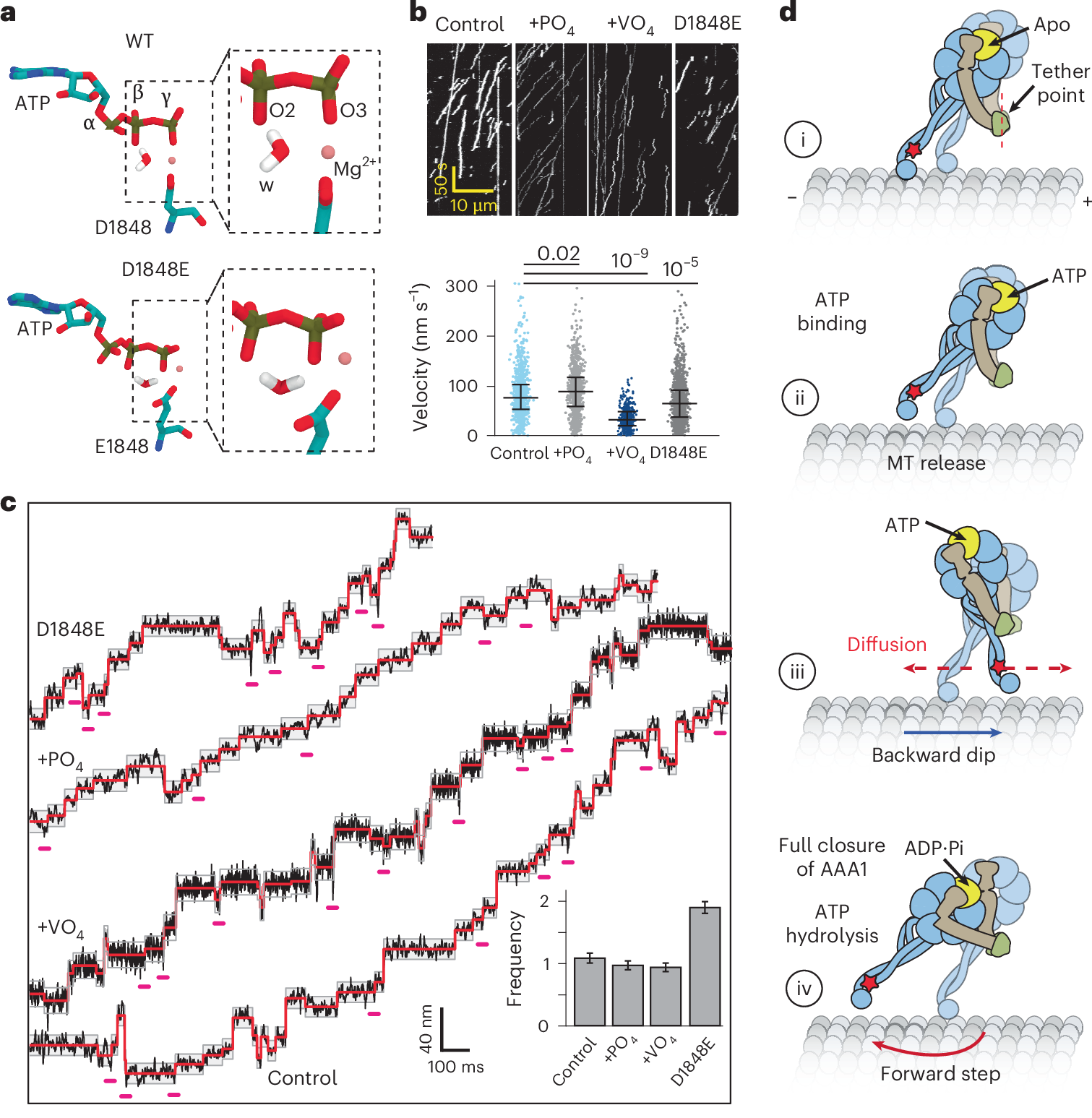
Our 2026 collaboration used MINFLUX tracking, biochemical perturbations and molecular dynamics to examine productive dynein stepping. The study resolved short backward displacements before forward steps and supported a mechanism in which ATP binding promotes release from the microtubule, while ATP hydrolysis generates a forward bias. The Gur group contributed the molecular dynamics component; collaborators performed the single-molecule tracking and associated experiments. These complementary measurements and models connect events at the ATP-binding site to nanometer-scale movement.
Related studies: Slivka et al. (2026), Characterizing dynamics of productive dynein stepping by MINFLUX.
Microtubule-associated proteins regulate access to the track
Microtubule-associated proteins can recruit motors while also creating obstacles to movement. Our MAP7 collaboration combined structural, computational and single-molecule approaches to show how distinct microtubule-binding and kinesin-binding regions regulate kinesin-1. The resulting picture goes beyond a passive roadblock: the same regulator can help recruit a motor and influence its ability to continue along the track.
Related studies: Ferro et al. (2022), Structural and functional insight into regulation of kinesin-1 by microtubule-associated protein MAP7.
Recent preprints: MAP9 and the tubulin modification landscape
Our MAP9 preprint, updated in August 2026, describes a helical binding mode around the microtubule that connects adjacent protofilaments. The collaborative study links this architecture to microtubule stabilization and differential motor regulation: MAP9 permits kinesin-3 and dynein movement while impeding kinesin-1 through interactions involving its loop-8 region. These results are publicly available as a preprint and have not yet completed journal peer review.
A July 2026 collaborative preprint examines how MTCL1 couples microtubule stabilization to tubulin acetylation. It reports that incorporation during microtubule assembly changes the luminal environment and promotes acetylation, linking assembly history to a chemical modification of the track. This work is also a preprint. It extends our transport program from the motor itself to the architecture and regulation of the microtubule.
Related studies: Cetin et al., Structure and mechanism of microtubule stabilization and motor regulation by MAP9. bioRxiv preprint, version 2, August 25, 2026; Perez-Bertoldi et al., Coupling of tubulin acetylation to microtubule stabilization through molecular mimicry. bioRxiv preprint, July 9, 2026.
From atomic interactions to transport behavior
The broader goal is to explain how the molecular state of a microtubule selects and regulates the motors that use it. We connect motor mechanics, microtubule-associated proteins and lattice organization within one framework for understanding intracellular transport. This direction provides a mechanistic foundation for studying how disrupted transport contributes to disease, while keeping ongoing research distinct from completed findings.