
Therapeutic Nanobodies & Protein Engineering
What makes a nanobody bind and inhibit its target?
Nanobodies are compact antibody-derived binding domains whose exposed loops recognize molecular surfaces. A useful binder must do more than fit a static structure: it must maintain productive interactions as both partners move, and its binding must produce the intended functional effect. We investigate the molecular basis of recognition, specificity and inhibition to support the design of nanobodies and other therapeutic proteins.
Our published studies use all-atom molecular dynamics and computational force spectroscopy to examine bound complexes, changes in binding orientation and dissociation pathways. We evaluate the interactions that stabilize an interface alongside repulsive interactions that weaken it. This mechanistic view connects sequence differences to behavior that a single docking pose cannot capture.
Related studies: Golcuk et al. (2021), Binding Mechanism of Neutralizing Nanobodies Targeting SARS-CoV-2 Spike Glycoprotein; Golcuk et al. (2022), SARS-CoV-2 Delta Variant Decreases Nanobody Binding and ACE2 Blocking Effectivity; Golcuk and Gur (2025), A Practical Covariance-Based Method for Efficient Detection of Protein-Protein Attractive and Repulsive Interactions in Molecular Dynamics Simulations.
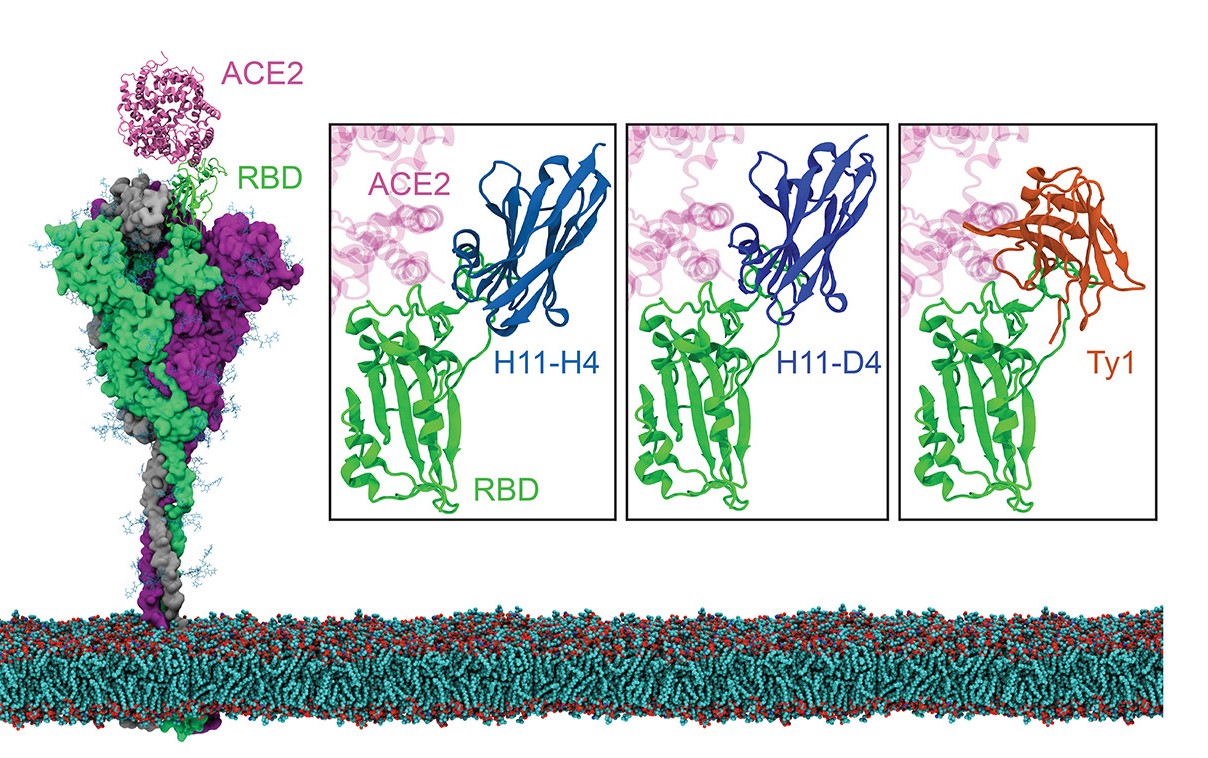
Different binding arrangements produce different inhibitory mechanisms
In our 2021 SARS-CoV-2 study, simulations distinguished the binding mechanisms of H11-H4, H11-D4 and Ty1. H11-H4 and H11-D4 could bind beside ACE2 on the spike receptor-binding domain. In the simulated complexes, electrostatic repulsion, particularly from H11-H4, displaced ACE2 from its binding site. Ty1 instead overlapped the ACE2-binding region. These results explain how nanobodies directed toward the same viral protein can interfere with receptor recognition through different molecular mechanisms.
Related studies: Golcuk et al. (2021), Binding Mechanism of Neutralizing Nanobodies Targeting SARS-CoV-2 Spike Glycoprotein.
Viral mutations reshape the interface
Our Delta-variant study found that the substitutions examined strengthened interactions between spike and ACE2 while weakening interactions with the three nanobodies studied. In those simulations, H11-H4 and H11-D4 no longer displaced ACE2 as they did in the ancestral complex. These are mechanistic findings for the specific variants and nanobodies tested, and they motivate examining an entire interface rather than assuming that a binder retains its behavior after its target changes.
Related studies: Golcuk et al. (2022), SARS-CoV-2 Delta Variant Decreases Nanobody Binding and ACE2 Blocking Effectivity.
From attraction to repulsion
Our September 2026 Omicron preprint extends this analysis to a broader set of nanobodies. It examines how substitutions alter binding orientations, remove favorable interactions and introduce unfavorable interactions at the interface. The work combines interaction fingerprints with simulated unbinding pathways to explain why different epitopes and nanobody loop sequences respond differently to the same viral substitutions. It remains a preprint; the reported binding and unbinding behavior is computational.
The covariance-based interaction analysis developed in our laboratory provides a practical way to locate these effects in large simulation datasets. It combines correlated residue motion with spatial proximity and physicochemical classification, making both stabilizing and destabilizing interactions accessible to interpretation.
Related studies: Golcuk et al., From Attraction to Repulsion: Omicron-Driven Rewiring of Nanobody Interfaces on the SARS-CoV-2 RBD. bioRxiv preprint, version 3, September 8, 2026; Golcuk and Gur (2025), A Practical Covariance-Based Method for Efficient Detection of Protein-Protein Attractive and Repulsive Interactions in Molecular Dynamics Simulations.

Physics-informed therapeutic design
Our broader direction is to use molecular mechanism to guide protein engineering and nanobody design against viruses. We focus on the relationship between sequence, conformational dynamics and functional interactions. Predictions about binding or inhibition must ultimately be connected to experimental measurements; a simulation result alone does not establish therapeutic efficacy. This research shares a common principle with our work on small-molecule modulators: understanding how a perturbation changes molecular behavior is central to designing an effective intervention.