
Virology & Infectious Disease
Which molecular events enable infection?
Pathogens depend on specific molecular transitions and interactions to engage a host or maintain a protective environment. We investigate these events at atomic resolution, focusing on how proteins change conformation, recognize binding partners and assemble into larger structures. Our published work includes SARS-CoV-2 spike recognition and the FapC amyloid scaffold of Pseudomonas biofilms.
These systems are biologically distinct but share a mechanistic question: how do sequence and molecular environment determine the structures and interactions that make a biological process possible? Simulations let us connect those variables while structural and biochemical collaborations anchor the models in experimental observations.
Related studies: Gur et al. (2020), Conformational transition of SARS-CoV-2 spike glycoprotein between its closed and open states; Taka et al. (2021), Critical interactions between the SARS-CoV-2 spike glycoprotein and the human ACE2 receptor; Hansen et al. (2025), Structural basis of Pseudomonas biofilm-forming functional amyloid FapC formation.
Spike opening and host-receptor recognition
Our SARS-CoV-2 studies examined the transition between closed and open spike conformations and the interactions between the receptor-binding domain and human ACE2. The opening transition changes access to the receptor-binding region, while the chemistry of the interface determines how the viral and host proteins interact. We investigated these complementary aspects through molecular dynamics, enhanced sampling and interaction analysis.
Subsequent simulations of the Delta and Omicron BA.1 and BA.2 variants examined how substitutions redistribute interactions with ACE2. These historical variant comparisons establish molecular principles of altered recognition; they are not presented as a description of which variants circulate today.
Related studies: Gur et al. (2020), Conformational transition of SARS-CoV-2 spike glycoprotein between its closed and open states; Taka et al. (2021), Critical interactions between the SARS-CoV-2 spike glycoprotein and the human ACE2 receptor; Golcuk et al. (2022), SARS-CoV-2 Delta Variant Decreases Nanobody Binding and ACE2 Blocking Effectivity; Golcuk, Yildiz and Gur (2022), Omicron BA.1 and BA.2 variants increase interactions of SARS-CoV-2 spike glycoprotein with ACE2.
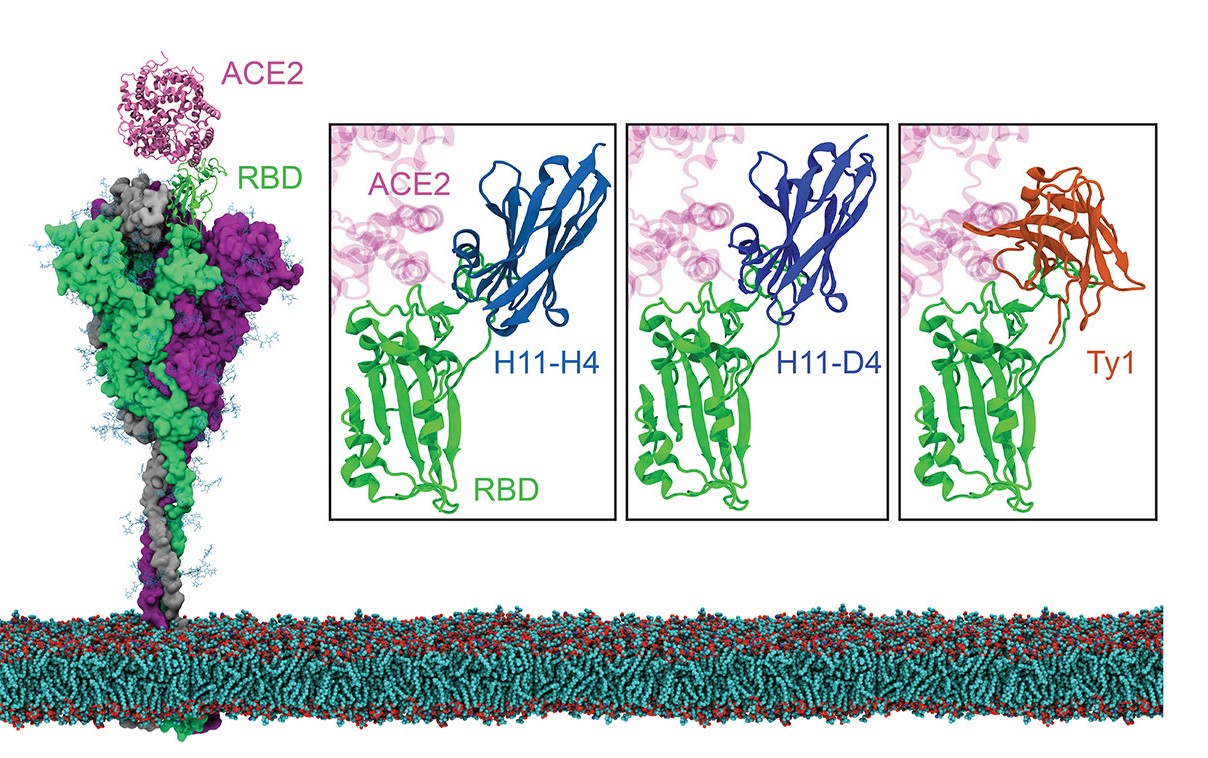
Molecular mechanisms of nanobody inhibition
Our nanobody studies distinguish direct competition for a binding region from disruption driven by interactions between molecules bound beside one another. They also show how viral substitutions can weaken a nanobody’s interface or change its ability to interfere with ACE2 recognition. The September 2026 Omicron preprint extends this work through comparative interaction fingerprints and simulated dissociation pathways. The preprint findings remain computational and are identified as such.
Related studies: Golcuk et al. (2021), Binding Mechanism of Neutralizing Nanobodies Targeting SARS-CoV-2 Spike Glycoprotein; Golcuk et al. (2022), SARS-CoV-2 Delta Variant Decreases Nanobody Binding and ACE2 Blocking Effectivity; Golcuk et al., From Attraction to Repulsion: Omicron-Driven Rewiring of Nanobody Interfaces on the SARS-CoV-2 RBD. bioRxiv preprint, version 3, September 8, 2026.
FapC amyloids and bacterial biofilms
Bacterial biofilms provide a different setting in which molecular assembly contributes to infection. Our 2025 FapC collaboration combined solution NMR, cryo-EM and all-atom simulations to connect the disordered monomer, folded subunit and fibrillar assembly. The cryo-EM structure revealed an irregular three-layer architecture, while simulations examined the rearrangements associated with formation and disruption of that fold.
This work explains how a functional amyloid contributes to a biofilm scaffold and identifies structural features relevant to future efforts to disrupt biofilm formation. It establishes a molecular foundation for intervention rather than demonstrating an antimicrobial treatment. Our group contributed the computational analysis within an integrative experimental collaboration.
Related studies: Hansen et al. (2025), Structural basis of Pseudomonas biofilm-forming functional amyloid FapC formation.

A mechanistic basis for intervention
Our broader interests include nanobody design against viruses and modulation of interactions involved in infection. We emphasize mechanisms that connect molecular recognition or assembly to biological function. The connection between protein motion and interaction specificity is central to this work.